
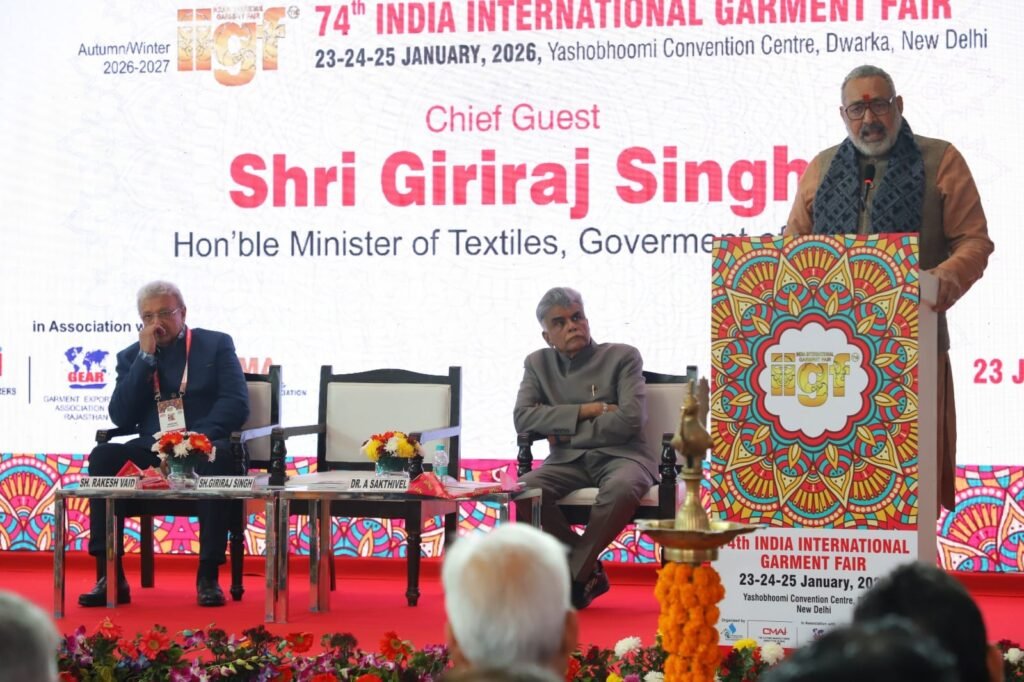
India’s textile and apparel sector continues to demonstrate strong momentum, doubling in value over the last decade and reinforcing its position as one of the country’s most important economic and employment drivers. This optimism was clearly reflected at the inauguration of the 74th Edition of the India International Garment Fair (IIGF), held at Yashobhoomi, Dwarka, New Delhi, on 23 January 2026.
The event was inaugurated by Shri Giriraj Singh, Hon’ble Union Minister for Textiles, in the presence of garment exporters, MSMEs, and international buyers from across key global markets. Following the inauguration, the Minister participated in the traditional lamp lighting, unveiled the official fair guide, addressed the gathering, and later visited exhibitor stalls.
IIGF Emerges as a Trusted Global Sourcing Platform
Addressing the audience, Shri Giriraj Singh described IIGF as a trusted and mature platform that has grown into a major global sourcing destination for international garment buyers. Recalling his previous visit, the Minister noted the consistency and credibility the fair has built over the years by bringing together manufacturers from across India and buyers from diverse geographies.
Highlighting government support to the sector, Shri Singh said the present administration has worked to remove structural barriers in textiles by addressing Quality Control Orders (QCOs), increasing RoDTEP and RoSCTL benefits, rectifying the inverted duty structure, and providing duty relief measures. He noted that nearly ₹50,000 crore has been extended to the industry through RoDTEP and RoSCTL schemes, underlining the government’s commitment to export competitiveness.
Textile Sector Doubles in Size Over a Decade
The Union Textiles Minister pointed out that India’s textile sector has witnessed tremendous growth over the last ten years, expanding from ₹8.4 lakh crore in 2014 to nearly ₹16 lakh crore today. The domestic textile market has also grown significantly, rising from around ₹6 lakh crore to nearly ₹13 lakh crore by 2025. Exports, meanwhile, have recorded a post-pandemic growth of over 25 per cent.
Emphasising resilience, Shri Singh stated that despite global headwinds, the industry has remained stable and adaptive. India’s export diversification efforts towards 40 new countries are already yielding results, with notable growth recorded in markets such as Argentina, Egypt, Poland, Japan, Sweden and France. He also expressed optimism over the impending India–EU trade agreement, expected to be signed shortly, which could further strengthen export prospects.
Building Indian Standards and Identity
In line with the vision of Aatmanirbhar Bharat, the Minister highlighted India’s move away from dependence on foreign benchmarks. Initiatives such as VisionNxt and IndiaSize are helping develop indigenous design forecasting and sizing standards that reflect Indian demographics and consumer preferences. He encouraged industry stakeholders to actively adopt Indian standards and contribute to building a distinct national design identity.
Strong Participation and Buyer Confidence: AEPC
Speaking at the inaugural function, Dr A. Sakthivel, Chairman, Apparel Export Promotion Council (AEPC), highlighted the scale and diversity of the 74th IIGF. The fair features 233 exhibitors spread across 5,073 square metres, with participation from all major garment manufacturing clusters in the country. Over 1,120 registered buyers have attended the event, reflecting sustained global interest in Indian apparel sourcing.
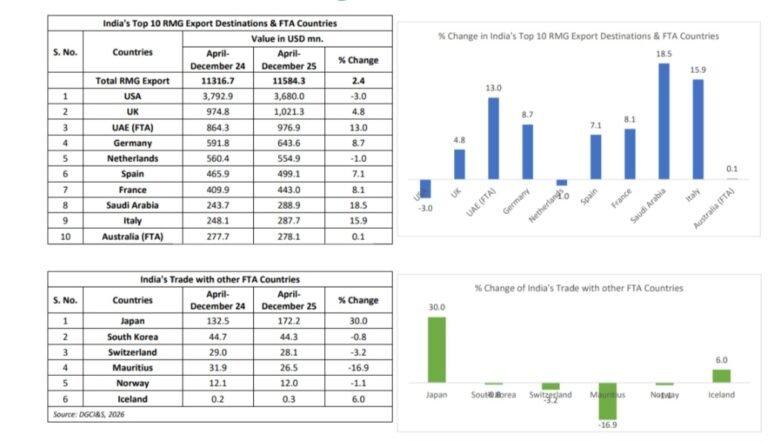
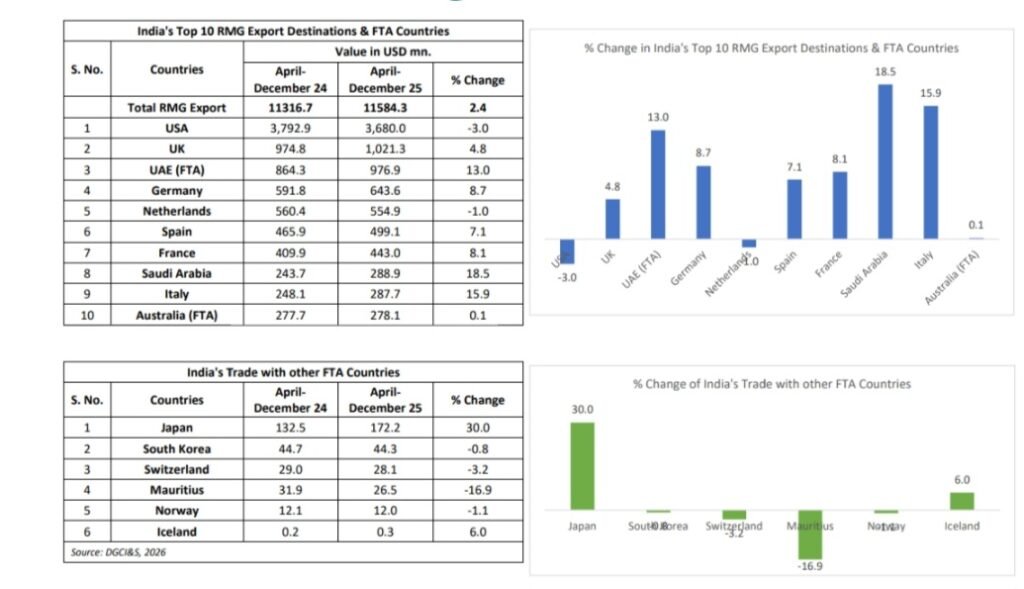
Dr Sakthivel noted that despite ongoing geopolitical and economic uncertainties, the Indian apparel industry has shown remarkable resilience. Cumulative RMG exports during April–December 2025–26 stood at USD 11.58 billion, registering a growth of 2.4 per cent over the corresponding period of the previous year.
Industry Seeks Policy Support to Sustain Momentum
While expressing confidence, the AEPC Chairman also highlighted key policy requests submitted to the government to strengthen export competitiveness. These include the introduction of a Focus Market Scheme for apparel exports to the USA, enhancement of interest subvention benefits, removal of value caps under the interest equalisation scheme, and improved liquidity support for MSME exporters.
According to Dr Sakthivel, such measures would provide timely relief and enable exporters to navigate challenging global conditions while safeguarding employment across the value chain.
Global Buyers Reinforce Trust in Indian Apparel
One of the defining features of the 74th IIGF has been the strong presence of international buyers representing leading global brands and retail chains. Buyers from the UAE, South Korea, South Africa, Saudi Arabia, Russia, Japan, Italy, Israel, Hong Kong, France, Mauritius, Spain and other markets are exploring sourcing opportunities from India.
Their participation, Dr Sakthivel said, is a clear endorsement of India’s capabilities in design, quality, compliance and reliable delivery.
Road to USD 40 Billion Apparel Exports
Looking ahead, AEPC expressed confidence that evolving trade dynamics, including the anticipated India–EU Free Trade Agreement and the gradual loss of preferential access by competing countries, will work in India’s favour. With coordinated efforts between industry and government, India remains well-positioned to achieve its ambitious target of USD 40 billion in apparel exports by 2030.
The inaugural session concluded with a vote of thanks by Shri Rakesh Vaid, Vice Chairman, IGFA, who acknowledged the collective efforts of exhibitors, buyers, organisers and policymakers in making the event a success.